
Review VAT on event tickets in the UAE, with invoice duties and illustrative calculations that separate taxable ticket sales from organizer payouts.
Ticket revenue reaches an organizer through several records, and the amount paid by the audience can differ from the amount transferred after service charges. For VAT on event tickets in the UAE, the tax calculation starts with the taxable supply and the supplier responsible for it. Someone reviewing a settlement statement needs to trace that statement back to the ticket transactions. Otherwise, a fee deducted from the payout can be mistaken for a reduction in taxable ticket sales.
Confirm the Supplier and VAT Registration
The organizer’s first tax review belongs ahead of the sales launch, when the contracting parties can confirm who supplies admission to the buyer. UAE VAT legislation distinguishes an agent trading in a principal’s name from an agent trading in its own name. If a ticketing business sells admission in the organizer’s name and on its behalf, the admission supply belongs to the organizer for VAT purposes. When the seller trades in its own name, review the resulting supply arrangement against Article 9.
For UAE-resident businesses, the FTA’s registration guidance states a mandatory threshold above AED 375,000 in taxable supplies and imports over the previous 12 months. Registration is required when that threshold is expected to be exceeded within the next 30 days. Calculate turnover at the business level across the applicable activities. Other taxable business sales belong in that turnover calculation alongside the revenue from the upcoming event.
Overseas organizers face different registration rules when they make taxable supplies in the UAE, even at turnover below the resident threshold. The FTA identifies an exception where another UAE party is responsible for settling the VAT on those supplies. Confirm the proposed arrangement with a UAE tax adviser. Ticket sales made through a local provider need review against the actual contract and the parties’ tax status.
Apply the Tax Treatment to the Admission
Paid admission to an ordinary UAE entertainment event supplied by a taxable person generally attracts the 5% VAT rate stated in Article 3. For cultural or artistic services, Article 30 places the supply where those services are performed. When an overseas buyer purchases admission to a concert in Dubai, the purchase still concerns a UAE event. The buyer’s foreign billing address alone leaves that event location unchanged.
Ticket packages deserve an assessment when admission is sold with another service, especially where the package price covers activities supplied by different businesses. The current Executive Regulation contains rules for composite supplies and multiple supplies. Since October 1, 2026, an added provision addresses economically interconnected components that require treatment as a composite supply. Ask the tax adviser to review the actual package. The invoice layout needs to correspond to the assessment based on the actual services supplied.

Calculate VAT Inside the Published Price
Public consumer prices for taxable supplies generally include VAT, as required by Article 27 in the Executive Regulation published by the FTA. Exceptions cover specified cases, such as supplies to VAT registrants where the price is identified as exclusive. For a consumer ticket page, agree the VAT-inclusive admission price when preparing the sales offer. The checkout total must correspond to the approved tax treatment.
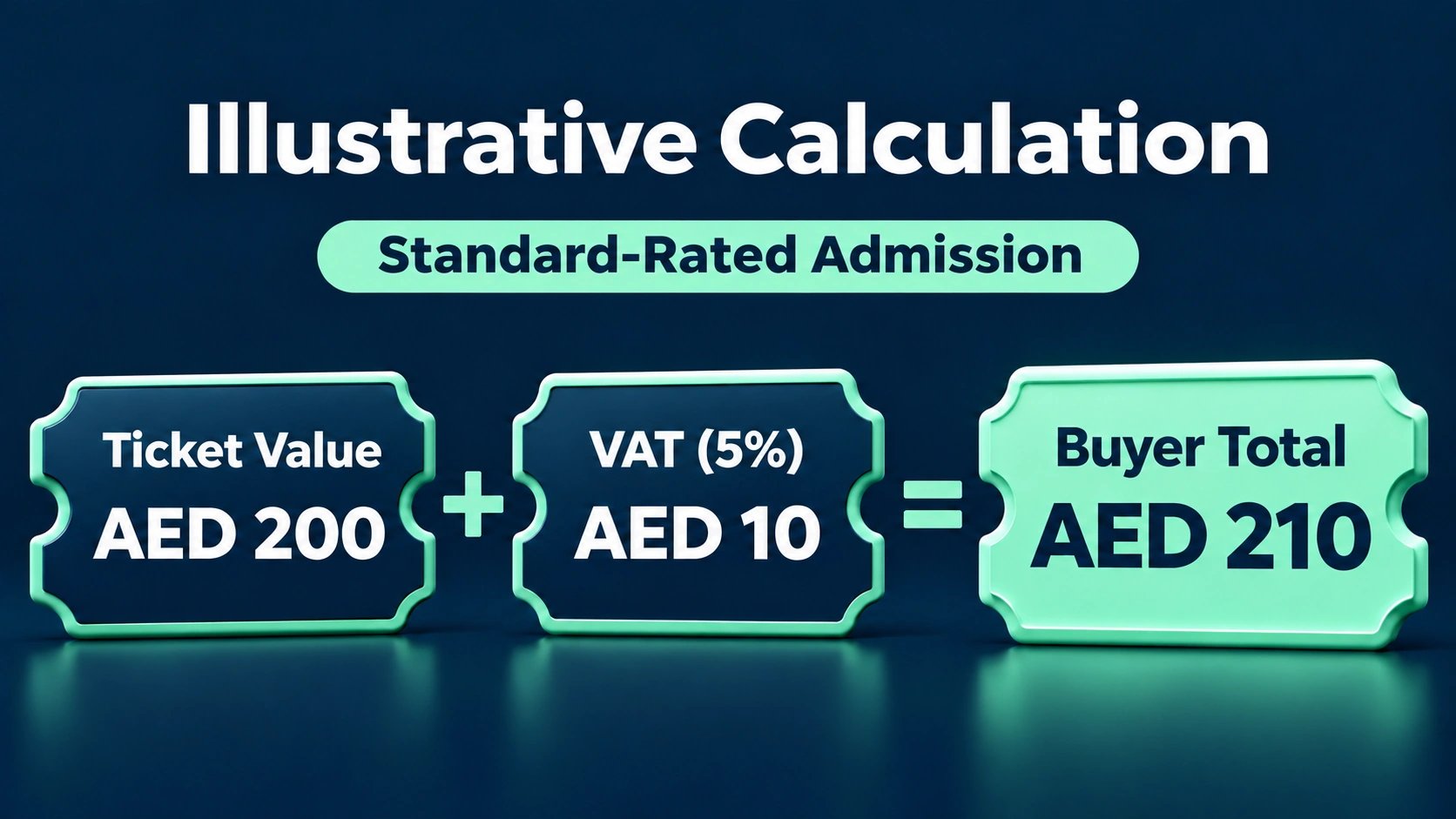
For an illustrative admission priced at AED 210 inclusive of 5% VAT, the ticket value excluding tax is AED 200 and the VAT is AED 10. Divide the inclusive price by 1.05 to calculate the value excluding VAT. Subtract that value from the inclusive price to obtain the tax component. Multiplication by 5% on AED 210 would produce AED 10.50, which overstates the VAT included in that price.
For an illustrative batch comprising 100 admissions sold at AED 210 per ticket, apply the same arithmetic on the stated assumption that all sales attract 5% VAT. Buyer payments total AED 21,000. After extracting AED 1,000 VAT, the ticket sales value excluding tax is AED 20,000. Actual reporting needs transaction-level amounts and the applicable rounding method, particularly when ticket prices contain fractional dirhams.
Separate Admission Tax from Service Charges
The ticketing agreement needs to state which party incurs the service charge and whether that charge is payable by the organizer or the buyer. Tax responsibility follows that supply arrangement. For an organizer paying a provider’s fee, obtain the provider’s invoice and review the VAT treatment of the fee as a purchased service. Even when deducted from settlement, the fee remains a cost requiring its own accounting record.
When a provider bills the buyer for a separate service, the invoice arrangement needs to identify the supplier responsible for that charge. Admission and a separate provider fee may appear within the same checkout total. Confirm how the buyer receives the relevant tax documents. Commercial labels such as “booking fee” describe the charge, yet the contract and actual service determine the applicable tax treatment.

Reconcile Gross Sales with Net Settlement
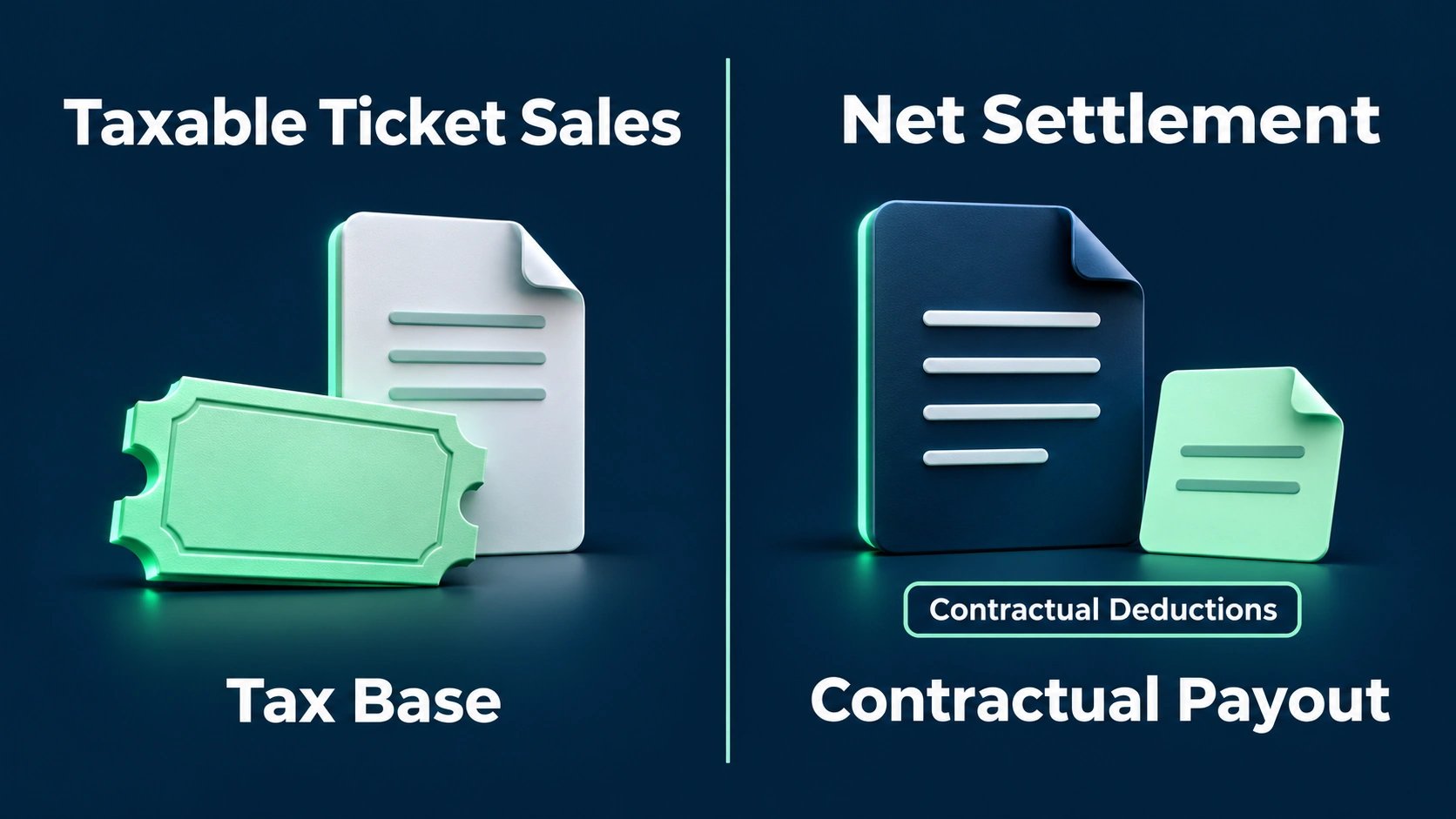
Organizers comparing sales against a payout need a reconciliation that explains the deductions applied between the buyer’s payment and the transfer received. Return to the illustrative AED 21,000 ticket-sales batch. If an agreed provider charge totals AED 1,050 and is deducted from that batch, the cash transferred becomes AED 19,950. The admission supply still carries AED 1,000 output VAT in this example.
After the provider’s deduction, the AED 19,950 payout records the cash received by the organizer following the agreed charge against ticket receipts. Any recoverable input VAT on the provider’s invoice requires its own eligibility review. Keep the admission tax calculation tied to the sales records. The provider’s invoice supports the cost entry, and the settlement statement explains the cash transferred.
Arrange the Invoice and Reporting Dates
Buyer tax documents must identify the supplier and record the VAT amounts associated with the purchase in accordance with the applicable invoice requirements. Article 59 specifies full and simplified tax invoices. For a full invoice, the required details include an invoice number and the issue date; other particulars cover the supplied service and amounts in AED. Buyer registration status can affect which invoice format is permitted.
For an authorized agent issuing a tax invoice on a principal’s behalf, Article 59 permits the arrangement subject to the specified record requirements. The principal and agent retain records that identify the other party. Agree one issuing route for the admission supply. Any separate invoice for a provider’s own service needs to correspond to that distinct supply.
Advance ticket sales need a tax-date review even when the event itself falls in a later reporting period than the customer payment. Article 25 links the tax date to the earliest applicable trigger, which can include receipt of payment or invoice issue. For ordinary full invoices, the general issuance period is 14 days from the supply date. Simplified invoices follow the supply date itself, subject to the applicable rules. Confirm the format and timing with the finance team ahead of sales.
Organizer Questions
Does a Foreign Buyer Change the VAT Treatment?
The event’s location remains relevant when a foreign buyer purchases admission to a UAE cultural or artistic event covered by Article 30. For admission to an event in Dubai, a foreign nationality or billing address leaves the physical event location unchanged. Obtain a transaction-specific review for unusual arrangements or packages.
Does a Smaller Payout Reduce Ticket VAT?
Service charges deducted by a provider reduce the cash transferred to an organizer, and the admission’s taxable value still follows the actual ticket supply. Calculate the tax from the admission records using the agreed VAT-inclusive price. Any tax treatment for the provider’s separate fee requires a separate invoice review.
Who Handles a Corporate Buyer’s Invoice Request?
The team responsible for issuing the admission invoice needs the corporate buyer’s invoicing details and tax registration status to select the appropriate format. Assign that responsibility in the ticketing agreement. Requests involving corrections belong with the appointed issuer so the final document corresponds to the recorded sale.
Agree the Sales Records Ahead of Launch
Someone’s Ticket describes sales reports with revenue and ticket-category detail on its public service page, so organizers can discuss the available data with its team. Ask which available records will support the finance team’s reconciliation. The event’s tax adviser determines the applicable treatment; the ticketing team needs that decision translated into the agreed sales setup. Contact Someone’s Ticket to discuss the event’s ticket sales and reporting requirements, with the proposed invoice arrangement ready for review.
Barbaros Bugra
Event Ticketing