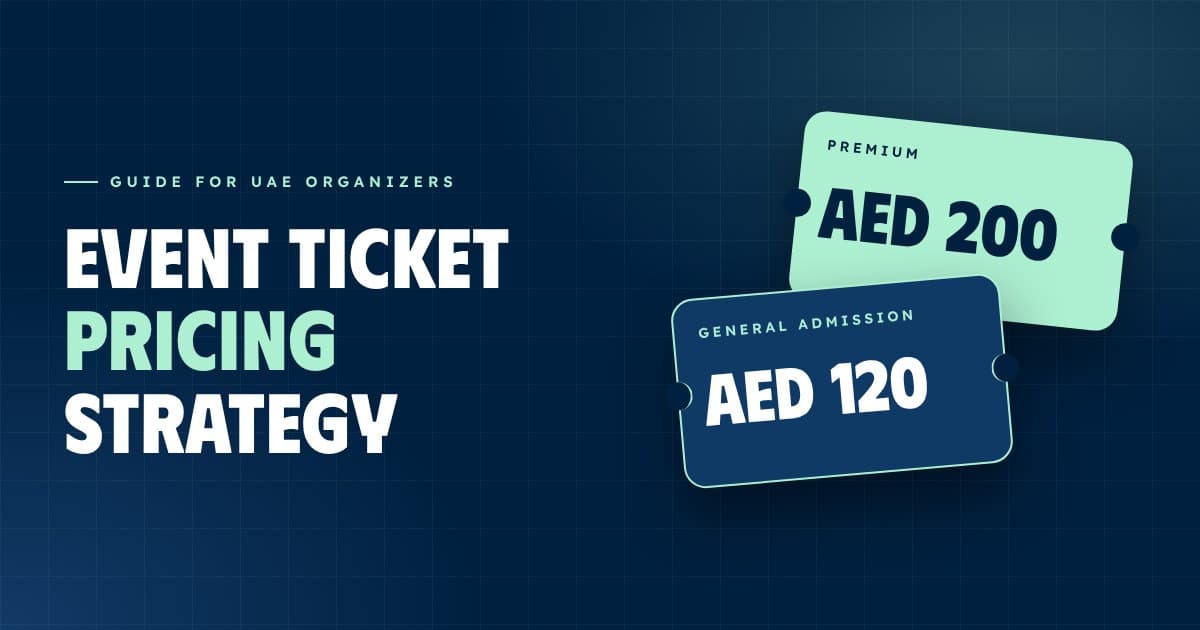
Compare event ticket prices against costs and paid attendance. Use fictional AED examples to assess sales forecasts and ticket categories for UAE events.
Your event ticket pricing strategy needs a sales estimate you are prepared to defend, since a price calculated against a full venue assumes every available ticket finds a buyer. Start the budget with the expected paid attendance at the proposed price. After the costs attached to those sales, how much remains to pay the event’s fixed bills?
For UAE organizers, the useful question is how a proposed price works with the event you have actually contracted and the audience you intend to reach. When comparing possible prices, estimate the likely purchases for both offers. Higher ticket receipts per buyer compensate for fewer purchases only up to a calculable point.
Calculate the Amount Available to Pay Event Costs
Fixed event costs belong in the budget at their contracted amounts, even when your attendance forecast falls below the original target. For venue hire, check whether the agreement charges a fixed amount for the agreed event period. If the venue charges per attendee instead, put that expense beside the attendee count used in the calculation.
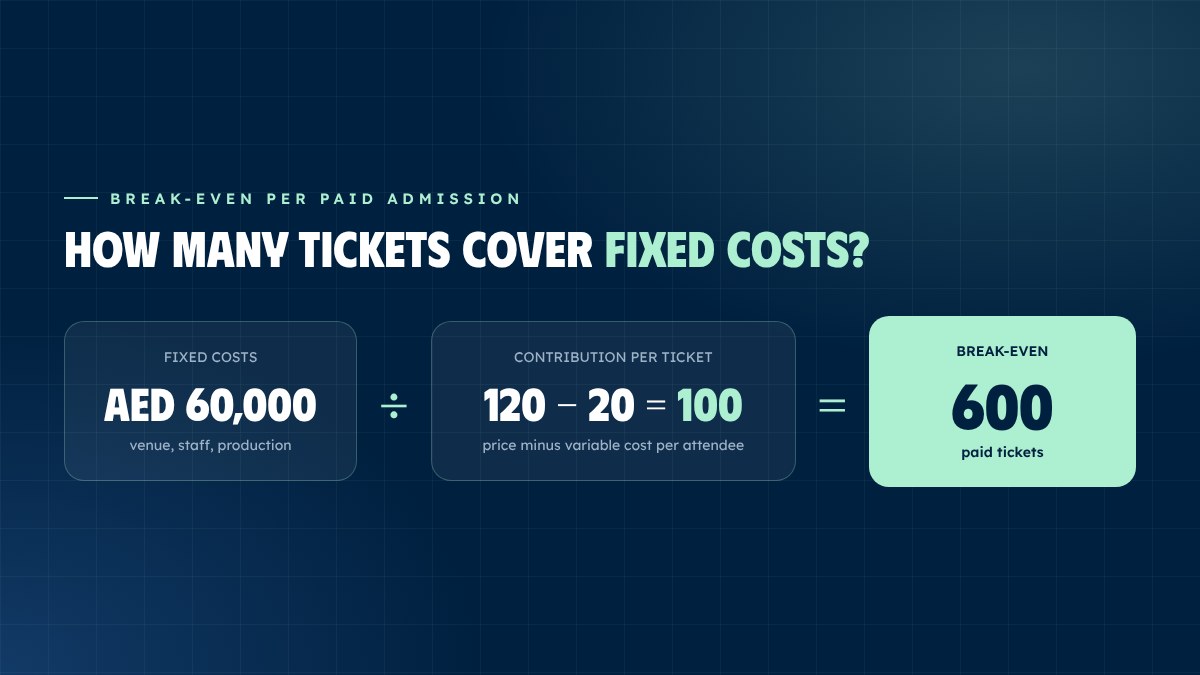
The U.S. Small Business Administration’s break-even calculation divides fixed costs by the selling price minus the variable cost per unit. For a ticketed event, the relevant unit is a paid admission. Apply the calculation on a consistent accounting basis after your finance adviser has assessed the applicable taxes and contractual deductions.
Your finance colleague calculates the projected contribution per ticket by deducting sale-related expenses from the revenue received for the admission. Since payment processing might be charged per order, use the expected number of tickets per purchase when estimating its per-ticket cost. Any included meal has its own cost attached to attendance. Count an expense once in the budget, with its charging basis beside the figure.
Test Two Prices Against Paid Attendance
For a fictional event used solely to explain the arithmetic, assume AED 60,000 in fixed costs and AED 20 in variable costs per paid attendee. When revenue per admission is AED 120 on the accounting basis in the example, the contribution is AED 100. After 600 paid admissions, the organizer has earned enough contributions to cover the fixed bill. Tax calculations are outside the scope of this fictional example.
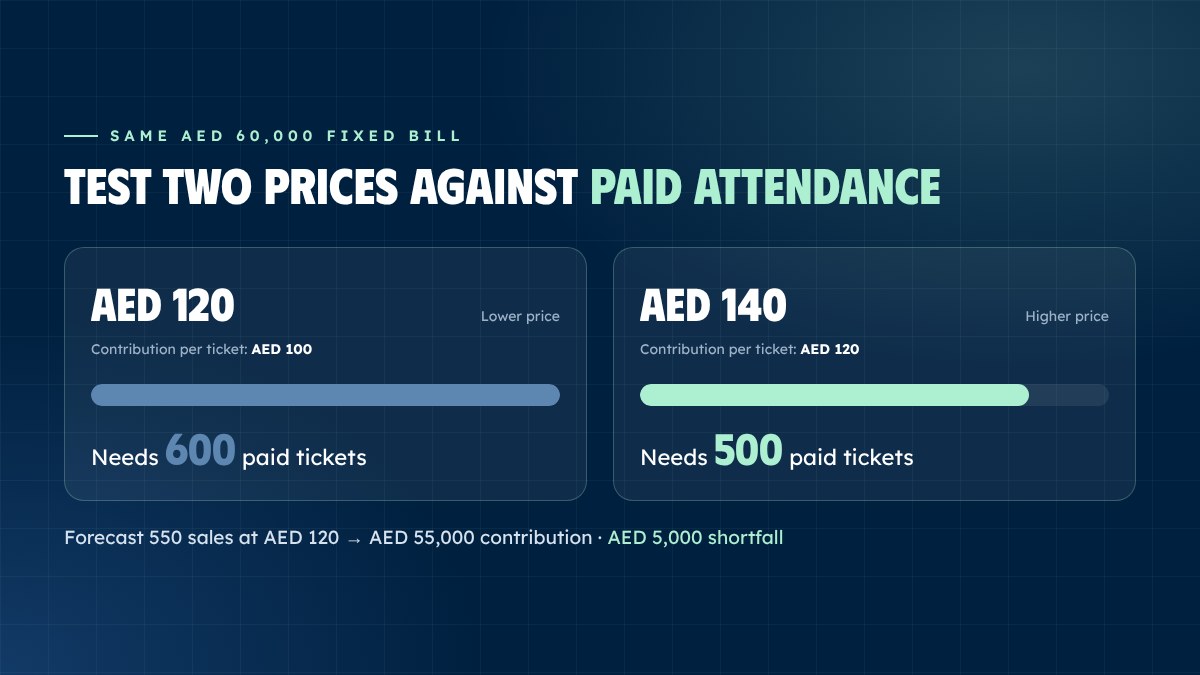
If the same fictional event earns AED 140 per admission, the contribution rises to AED 120, and the break-even quantity falls to 500 tickets. To reach AED 60,000 in contributions, the organizer needs either 600 purchases at the lower price or 500 at the higher price. Evidence concerning the audience’s willingness to pay AED 140 informs the decision between those offers.
Suppose the organizer instead expects 550 purchases at AED 120, based on comparable sales records and the current event’s audience. The projected contribution is AED 55,000, compared with the fixed bill of AED 60,000. To address the AED 5,000 shortfall through a price increase, revise the sales forecast for the proposed offer. Another option is to renegotiate a contracted expense; assess any resulting change in events against the admission already advertised.
Use Comparable Purchases to Estimate Demand
Past sales records help when the earlier event’s location and admission offer resemble those for the event you are pricing for the upcoming date. For a previous concert, retain the actual amount paid in each category alongside its purchased quantity. Complimentary admissions belong outside the paid-demand estimate. If a previous report includes refunded purchases, reconcile those adjustments prior to using its totals.
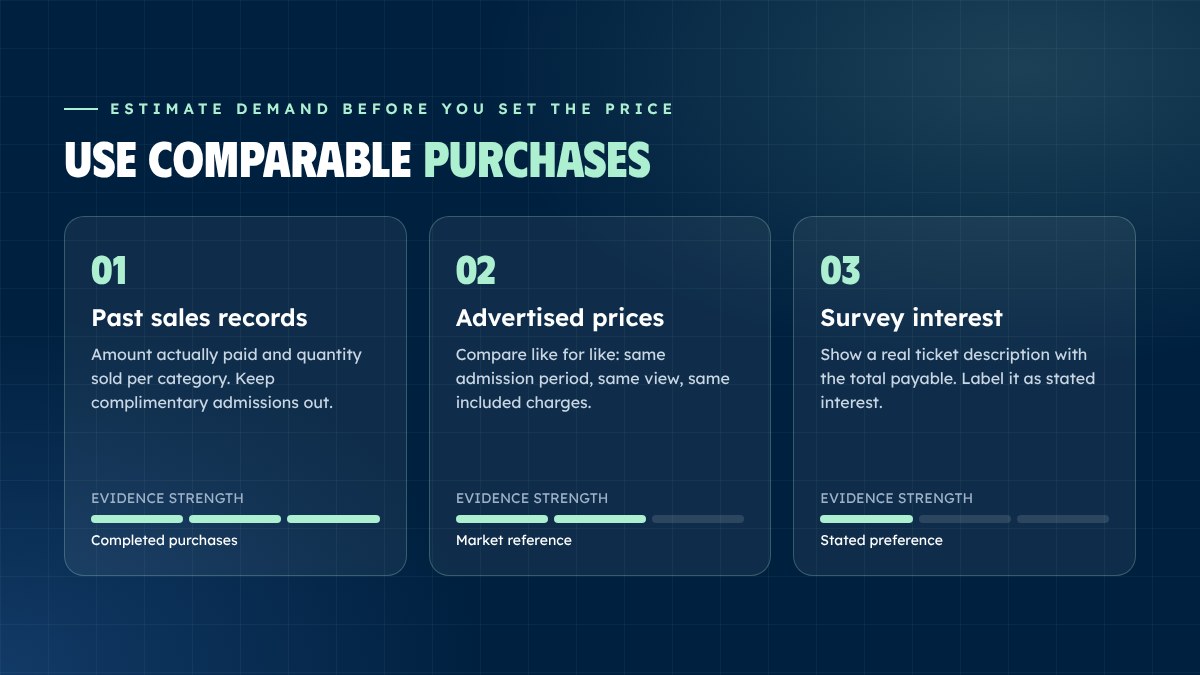
Publicly advertised prices provide useful comparisons only after you examine what the buyer receives and which charges apply to the purchase. Compare the same admission period when one event sells a day ticket, and another sells a weekend pass. For seated events, check the view associated with the price. Record the observation date so a later price change has a traceable reference.
Interest expressed in a survey deserves its own label when your team uses it to estimate how many people will purchase at a proposed price. Ask participants to assess an actual ticket description with the total payable amount. Stated preferences help investigate the offer; completed purchases provide evidence concerning the money buyers have spent. Retain the distinction in the budget’s assumptions.
Price Differences Need a Buyer Reason
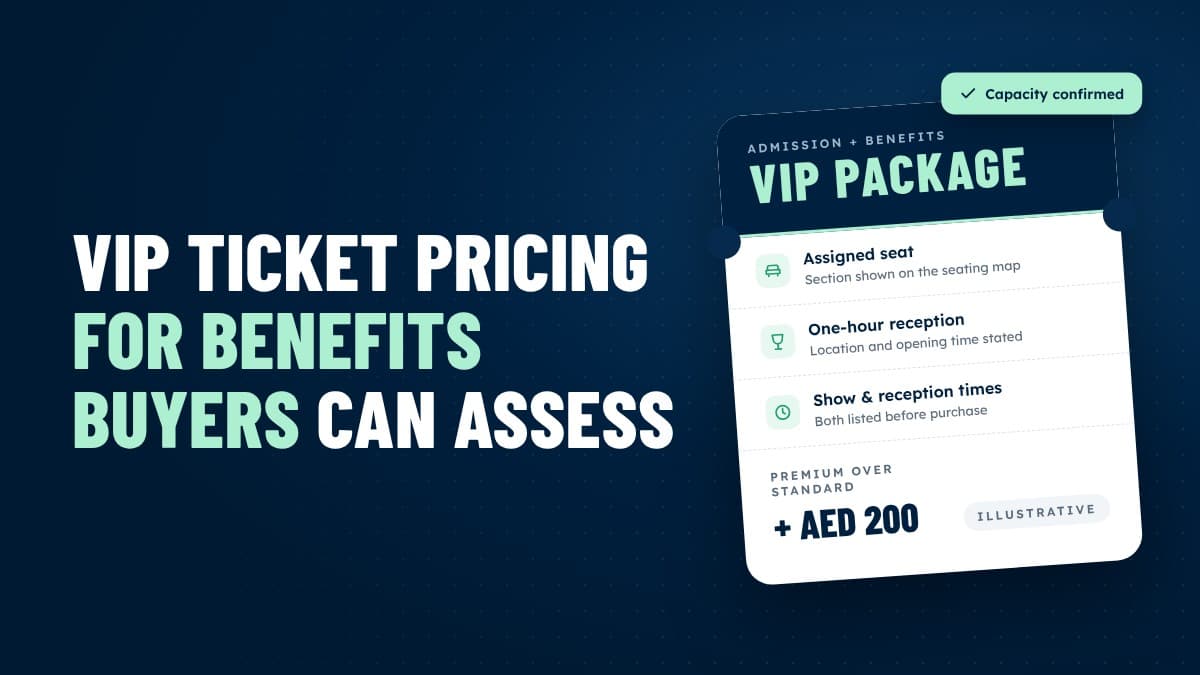
Buyers comparing ticket categories need enough information on the event page to judge what the additional payments are for. For reserved seats, identify the relevant section on the seating map. If another category includes hospitality, calculate the additional delivery cost and confirm the proposed service with the venue. Its price premium needs to pay for those additions as part of the event’s overall financial plan.
Published on June 14, 2024, a concert ticket preference study analyzed choices from 215 U.S. respondents after excluding responses with quality problems. In the experiment, participants selected tickets for a hypothetical concert using a venue map. The analysis found stronger preferences for certain areas near the stage. Among older respondents and respondents with children, preferences for reserved seating differed from those of the other participants. For a UAE event, those results support asking specific questions concerning the proposed seating offer; local price decisions still need evidence from the intended audience.
If your budget assumes premium tickets will sell at the same rate as the least expensive category, examine the evidence supporting that assumption. Prepare a separate quantity estimate for the premium offer, then calculate the combined contribution using the expected sales for both categories. If premium demand proves weaker, calculate whether lower-priced sales could recover the shortfall within the remaining approved capacity.
Check the Average Price Against the Actual Sales Mix
The average revenue per paid ticket varies as buyers purchase different proportions of the available categories, even when published prices remain unchanged. In a fictional two-category event, 400 purchases at AED 100 and 100 purchases at AED 200 produce AED 60,000 in ticket revenue. Across those 500 admissions, the average is AED 120. Use the category quantities to calculate the average, while retaining the two listed prices in their own rows.
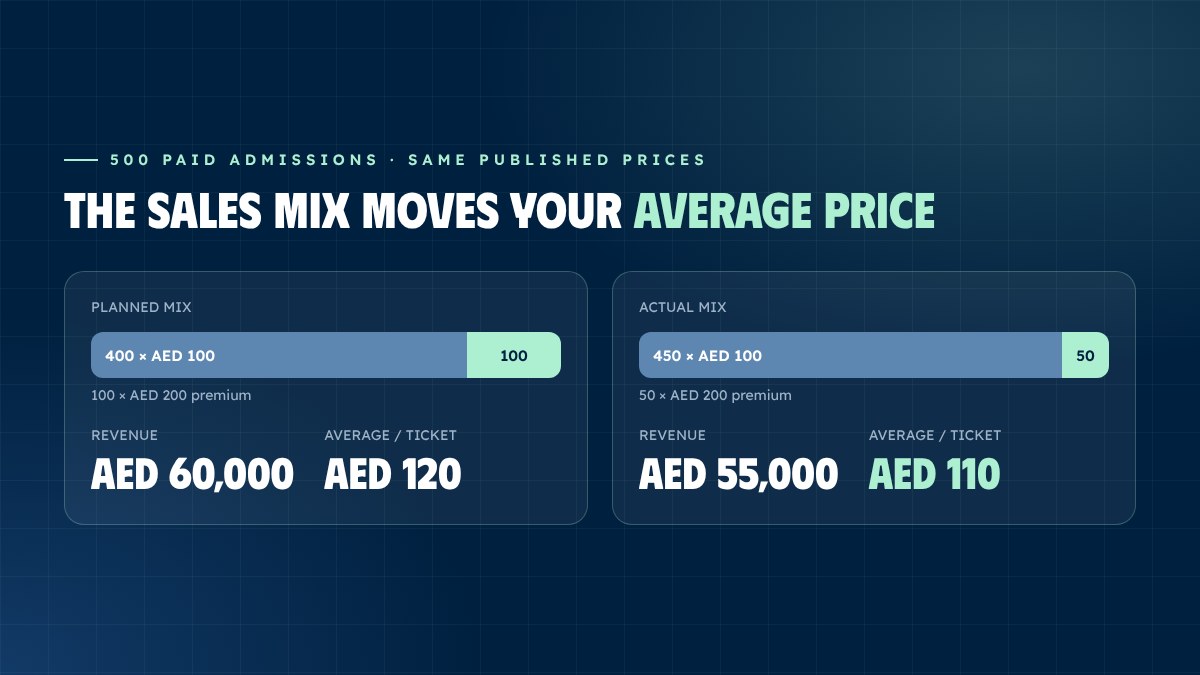
If the same 500 admissions comprise 450 purchases at AED 100 and 50 at AED 200, revenue falls to AED 55,000. The revised average is AED 110. Recalculate expenses associated with premium benefits using the amended quantities. For the next sales estimate, retain the remaining available quantity beside its corresponding ticket price.
Prepare a Price Instruction the Provider Can Apply
Once the organizer approves the proposed prices, the ticketing provider needs the corresponding quantities and the admission description for the tickets entering sale. Include the buyer’s payable total alongside the organizer’s expected proceeds. In the proposed checkout demonstration, check where mandatory charges appear; your finance adviser needs to confirm the applicable tax treatment. Someone’s Ticket’s discussion of ticketing service responsibilities covers the appointment discussion for that work.
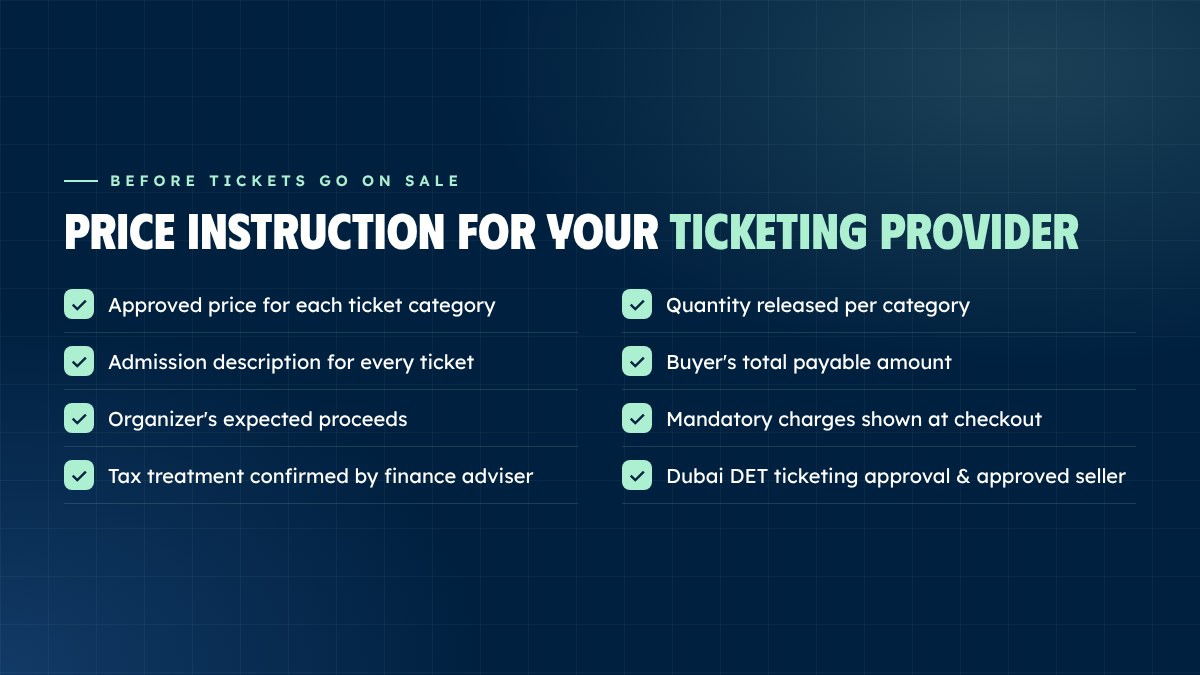
Dubai DET’s ticketing application instructions require organizers holding a valid ticketed-event permit to complete a further ticketing application and select an approved seller or registration provider. Confirm the applicable approval conditions with the appointed provider when preparing the price instruction. For an event in another emirate, obtain confirmation from its responsible authority.
Questions on Event Ticket Pricing Strategy
How Does Complimentary Admission Affect the Price Calculation?
Complementary places reduce the quantity available for paid sales when both draw from the same approved audience allocation for the event. Include their delivery costs in the budget if the organizer pays expenses for those guests. For the required contribution calculation, use the remaining paid inventory and a realistic purchase forecast.
When Does a Discount Require Extra Sales?
Discounts reduce the contribution from affected tickets, so calculate the additional purchases required to offset that reduction using the revised contribution per admission. If a discounted purchase replaces a full-price purchase, include the lost contribution in the comparison. Set the discount’s quantity limit against the event’s remaining available inventory.
What Information Belongs in a Pricing Review?
Completed sales by ticket category should be shown alongside the current forecast when the organizer reviews a price proposal with the finance colleague. Include the expenses associated with the proposed change. Where a new price is approved, record its applicable quantity and effective date in the instruction sent to the ticketing provider.
Discuss the Proposed Ticket Prices
Someone’s Ticket provides event ticketing technology, with the arrangements for your proposed categories requiring confirmation against the actual event brief. When you contact the team, supply the event date and venue with your approved price proposal. Ask for confirmation showing the buyer’s total and the deductions used to calculate the organizer’s proceeds, so the finance colleague can reconcile the offer against the event budget.
Barbaros Bugra
Event Ticketing