Plan an early bird ticket strategy with a credible closing date. Compare discounted allocations and checkout rules for the ticket release at your event.
Your early-bird ticket strategy needs an ending you are prepared to honor, with a price reduction that supports a specific commercial objective. If you want buyers to purchase earlier, decide how much revenue you will exchange for that earlier decision. Set the discounted allocation against the actual event inventory, then agree on what happens when the offer closes.
Early purchases help an organizer assess demand while there is still time to revise spending decisions for the event. If the early release is intended to pay a supplier deposit, the provider’s settlement agreement needs to permit payment to the organizer by that bill’s due date. Obtain the expected settlement date in writing when agreeing to the release. Ticket revenue awaiting settlement belongs outside the cash available for that bill.
Choose the Launch Date Around Confirmed Event Information
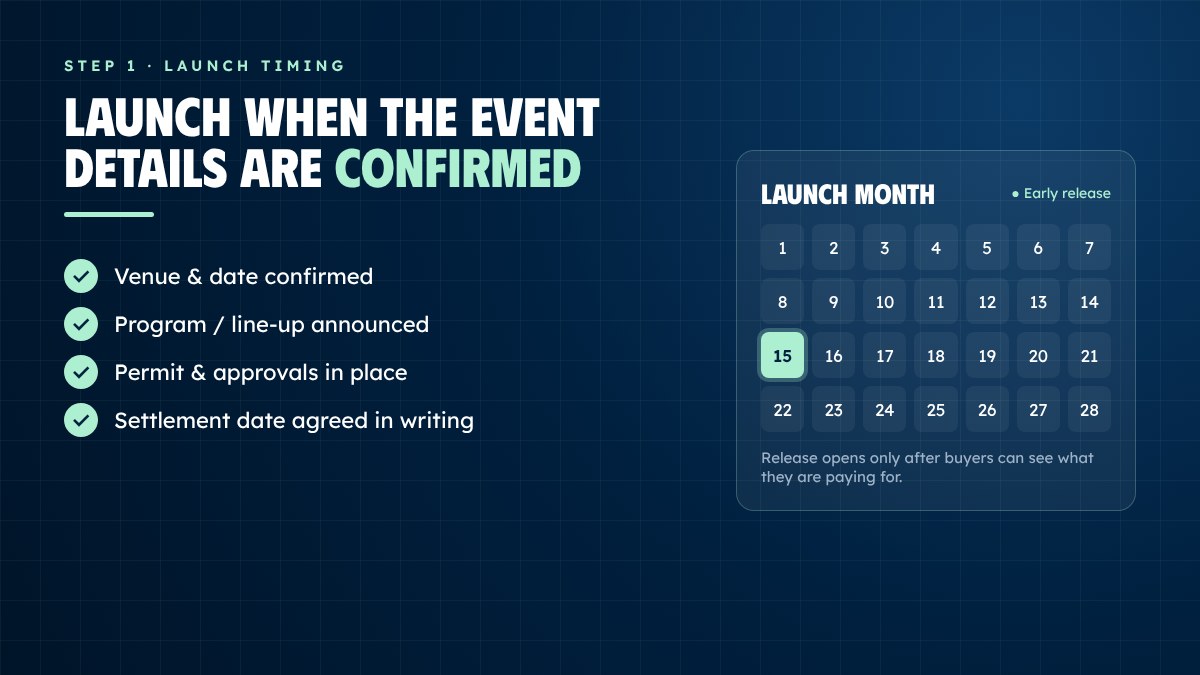
Buyers purchasing several months in advance need sufficient event information to assess the offer, especially when travel arrangements depend on the advertised date. Confirm the venue and the admission description for the proposed release. If the program includes provisional arrangements, describe those qualifications beside the offer in language consistent with the applicable booking terms.
Dubai DET’s ticketing application instructions require organizers holding a valid ticketed-event permit to complete a further ticketing application and select an approved seller or registration provider. Agree on the release date after the responsible parties confirm the applicable approvals. For another emirate, the relevant local authority supplies the jurisdiction-specific requirements. Early purchase offers remain subject to the event’s applicable approval conditions.
For a returning conference, the launch might coincide with a confirmed program announcement that previous delegates have been waiting to read. After reviewing the announced sessions, a prospective delegate has specific information to discuss with the colleague who approves attendance expenses. Where promotion begins with an unfamiliar event, allow enough time for prospective buyers to examine its content. Choose the sales period based on evidence from comparable events, including the current audience’s decision time in the estimate.
Treat the Discount as an Expense Worth Testing
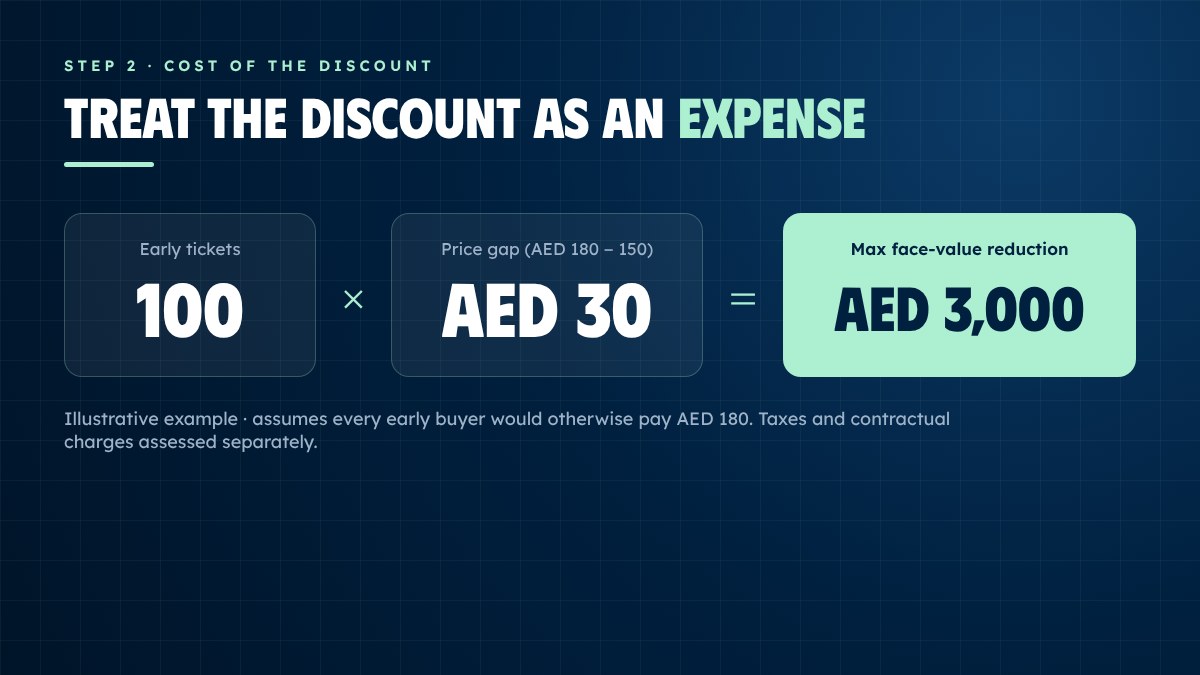
Early purchases have different commercial value when they come from additional attendees compared with buyers who would have purchased at a later price. For the latter group, the organizer exchanges revenue for earlier payment. Assess that exchange against the actual benefit sought, such as reducing uncertainty ahead of a venue expenditure decision.
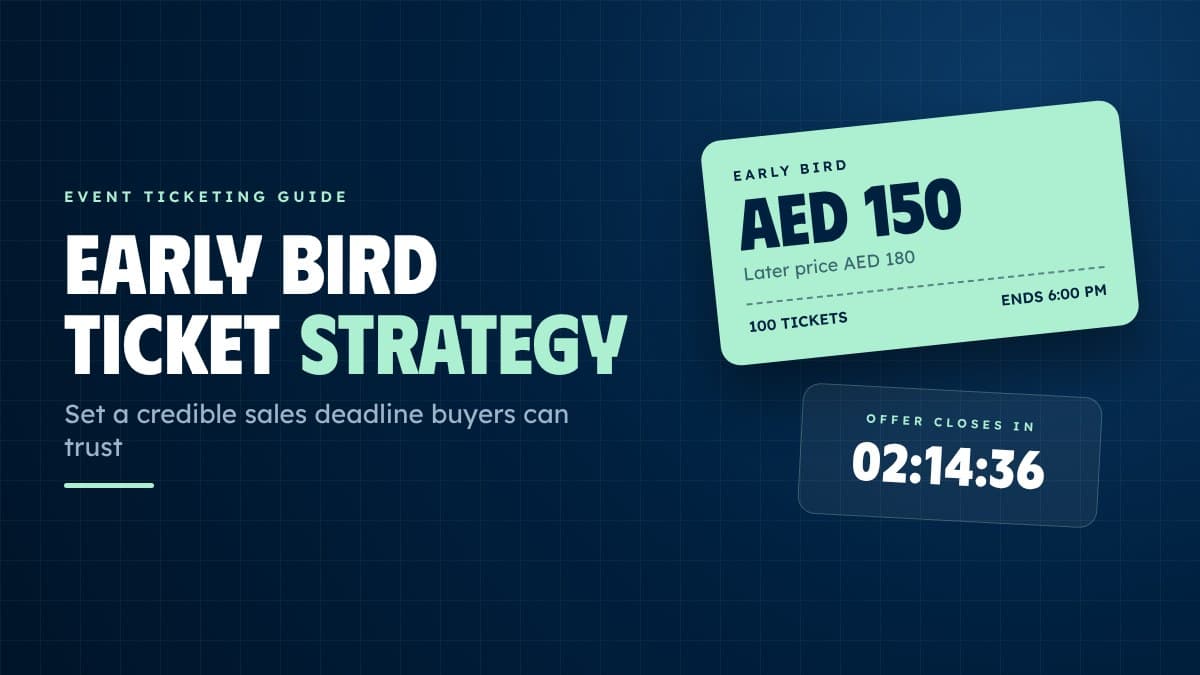
For a fictional calculation, suppose an organizer releases 100 early tickets at AED 150, followed by a later price of AED 180 for the same admission. Compared with selling those 100 tickets at AED 180, the maximum face-value reduction is AED 3,000. Taxes and contractual charges require separate assessment. To isolate the discount’s cost, the example assumes all 100 buyers would otherwise purchase at AED 180; actual demand requires its own forecast.
If some early buyers would otherwise miss the event, their purchases change the comparison and deserve a separate estimate in the review. Use past purchase records when comparable events provide suitable evidence. For a first event, keep the uncertainty visible in the budget and limit the initial discounted quantity. Percentages borrowed from unrelated promotions need to be tested against your own audience’s likely purchases.
Decide How Much Inventory Enters the Early Release
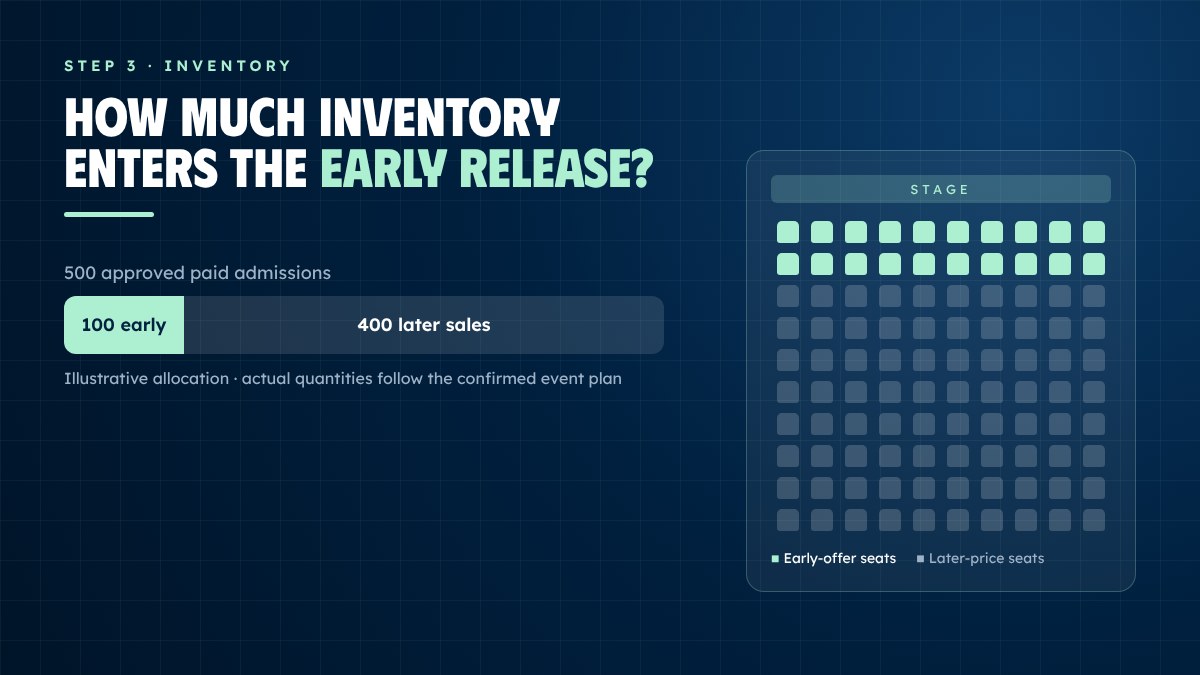
Your discounted allocation comes from the event’s approved paid inventory, after deducting places already assigned to other admission arrangements. If 500 paid admissions remain available and 100 enter the early offer, 400 remain for later sales. Actual quantities follow the confirmed event plan; the fictional allocation used here is solely to explain the calculation.
For a seated event, evaluate which seats qualify for the offer rather than choosing the early quantity solely as a percentage of the auditorium. If the early allocation contains the most desirable seats, later buyers will assess the remaining locations at a higher price. Compare the seat descriptions attached to both prices, then estimate demand for the remaining locations. The later sales forecast needs to describe the tickets actually left for purchase.
Research published in 2013 examined advanced sports-ticket purchase decisions and reported that participants’ perceived chances of finding tickets or a lower price increased as game day approached. For a UAE event, use those sports findings to formulate questions for the intended audience concerning future availability and expected prices. Local responses are needed to assess those expectations for the proposed event.
Write the Closing Condition Buyers Will See
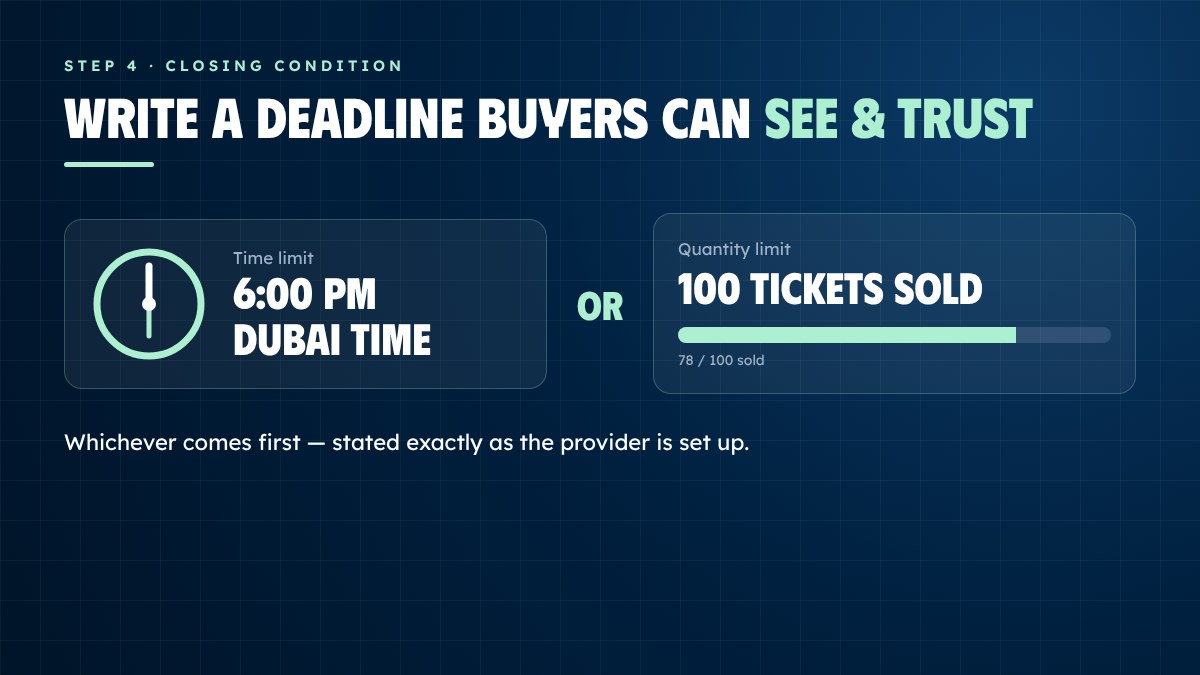
The early offer needs a closing condition that matches the provider’s actual setup, whether it ends at a specified time or after a specified quantity sells. When both limits apply, state that the offer ends at the first limit reached. Include the time zone beside the closing time for buyers outside the UAE.
Suppose an illustrative release offers 100 tickets until 6 p.m. Dubai time on a stated date, and closes sooner if the allocation sells out. The provider then needs instructions for the remaining tickets when the deadline arrives. If 76 have sold, decide in advance whether the remaining 24 move to the later price. The published limit concerns that discounted allocation; the event’s total remaining capacity requires its own description.
In its 2022 report on deceptive online design, the U.S. Federal Trade Commission identifies misleading countdowns attached to offers that continue after the displayed clock expires. For an event campaign, publish a genuine end time and apply it to the actual offer. The report supplies consumer-protection context from the United States, separate from the UAE requirements applicable to your event.
Test the Price Change at the Checkout Boundary
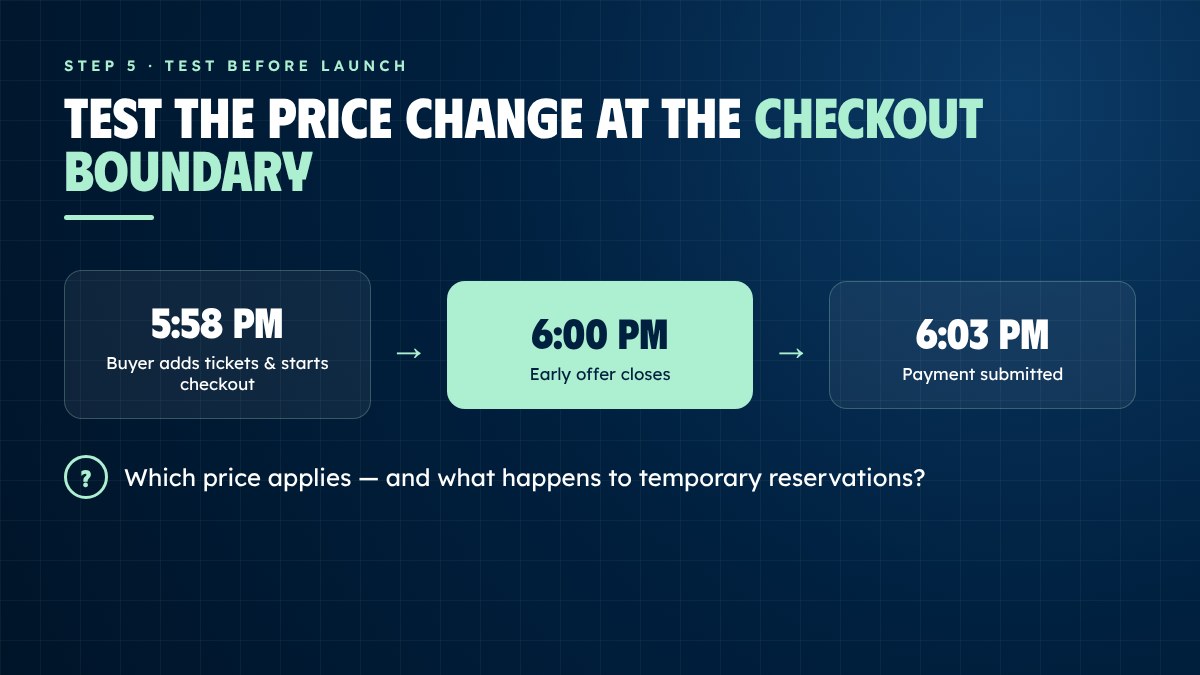
Your provider’s demonstration needs to include a buyer who starts checkout shortly ahead of the deadline and completes payment after the public price changes. If the provider retains the earlier price during checkout, buyers need to see when that price expires. Ask the provider to demonstrate the agreed behavior using its authorized test procedure.
Temporary reservations deserve separate treatment when the last early tickets appear unavailable while purchasers are still completing payment. If an unpaid reservation expires, the released ticket’s price must follow the agreed-upon closing rule. The organizer’s instructions must cover that case alongside the public sales deadline. Exact reservation behavior requires confirmation from the appointed provider for the event.
Someone’s Ticket’s article on online ticket sales explains the wider release preparation, with sections addressing buyer information and purchase testing. For an early offer, add the price transition to that preparation. Retain the approved test result with the release instruction so the sales team has the same answer when a buyer asks which price applies.
Read the Results After the Early Offer Closes
The early campaign’s sales report needs the paid quantity at the closing time, with later refunds accounted for when assessing retained revenue. Compare actual purchases with the forecast used to approve the discount. If promotional spending increased during the offer period, include that additional expense when assessing its commercial results.
Later buyers face a higher price and a shorter decision period, so the early purchase rate needs reassessment when preparing the forecast for the remaining campaign. Review the remaining inventory against its advertised offer. Past events help only where their audiences and sales conditions provide a useful comparison. Early purchasers may include returning supporters whose buying behavior differs from that of people still considering attendance.
Questions on Early Bird Ticket Strategy
Does Early Bird Admission Include an Earlier Entrance Time?
Early purchase pricing concerns when a buyer buys the ticket, with any separate entrance privilege requiring an explicit description in the admission offer. If doors open at the same time for both price levels, retain that admission time in both ticket descriptions. Staff then check the admission rights actually purchased.
How Large Should the Early Discount Be?
The acceptable reduction is based on the event’s revenue requirements and the organizer’s estimate of additional purchases or earlier payment benefits. Calculate its maximum cost at the proposed allocation, then test the remaining sales forecast at the later price. Published industry percentages require evidence relevant to the event you are selling.
What Happens After a Weak Early Release?
If early sales fall below forecast, investigate the audience reached during the campaign and the offer they received before approving another discounted release. Separate incomplete purchases from completed sales in the report. If buyers need confirmed program information to decide, address that gap in the next campaign decision.
Discuss the Release with Someone’s Ticket
Someone’s Ticket provides event ticketing technology, with the proposed release arrangements requiring confirmation for your event’s actual admission offer. When you contact the team, supply the planned quantity and closing condition. Request confirmation of the price transition, followed by a demonstration of the checkout case that crosses the deadline.
Barbaros Bugra
Event Ticketing